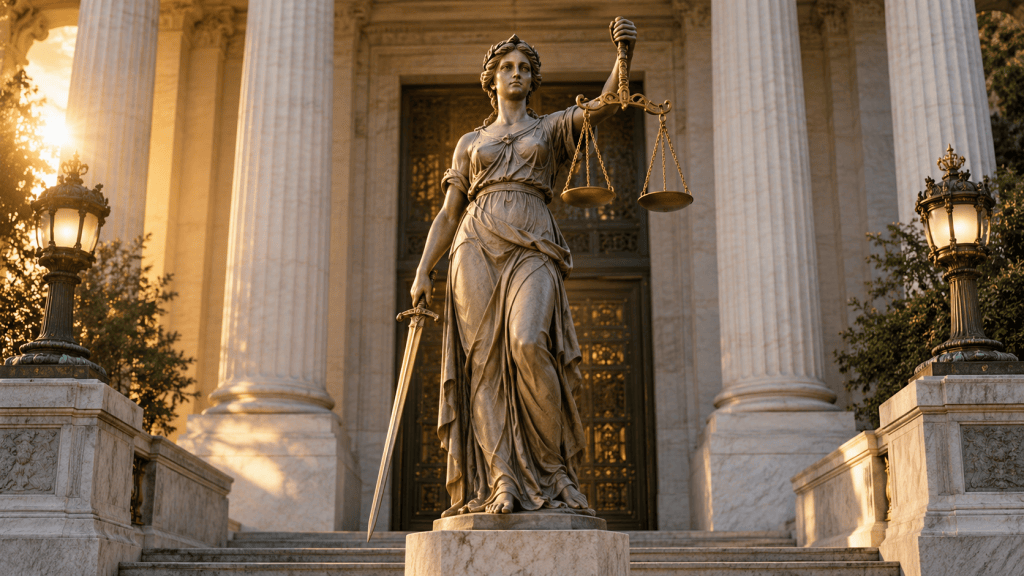
This is an incredibly vulnerable post, but I am opening myself up so do not destroy me please. I was recently collecting photographs for the Eterna Law website when I noticed something I had somehow overlooked before.
Women are everywhere in the architecture of the law. Carved into courthouses. Built into facades. Standing above entrances. Appearing in reliefs, statues, seals, and emblems. Again and again, when society is asked to represent justice itself, it gives justice the face and body of a woman.
I had to stop and think about that.
Because as a female attorney, I have spent more time than I would like to admit wondering whether I am built correctly for this profession. I am not particularly loud. I do not enjoy taking up all the space in a courtroom. Too quiet. Too unsure. Too thoughtful. Aggression does not come naturally to me simply because there is a dispute. I am always willing to say, that makes sense. I have watched attorneys whose voices are bigger, whose physical presence is bigger, whose style is more confrontational, and somewhere along the way I absorbed the idea that this was what a strong lawyer was supposed to look like. Loud. Fierce. Demanding. Full of rage. That what every client needed was someone to punch out the other side, a protector who was also an aggressor. And if I did not look like that, perhaps I was somehow less suited for the work.
There is something quietly self-deprecating embedded in that belief. The assumption that strength belongs more naturally to someone else and not to me.
And then I walk into my courthouse and I am greeted by an enormous gold statue of a woman carrying the scales.
Lady Justice.
She is large. She is commanding.
She demands attention
But she is not yelling.
She is not overpowering anyone.
Her face is calm. Her features are serene.
She stands.
She holds the scales.
She weighs.
She considers.
She carries authority without having to perform it.
And I find that deeply beautiful.
It has made me think about the ways I have defined strength in my own life and in my own practice.
I am beginning to understand that strength can be feminine.
Strength can look like empathy.
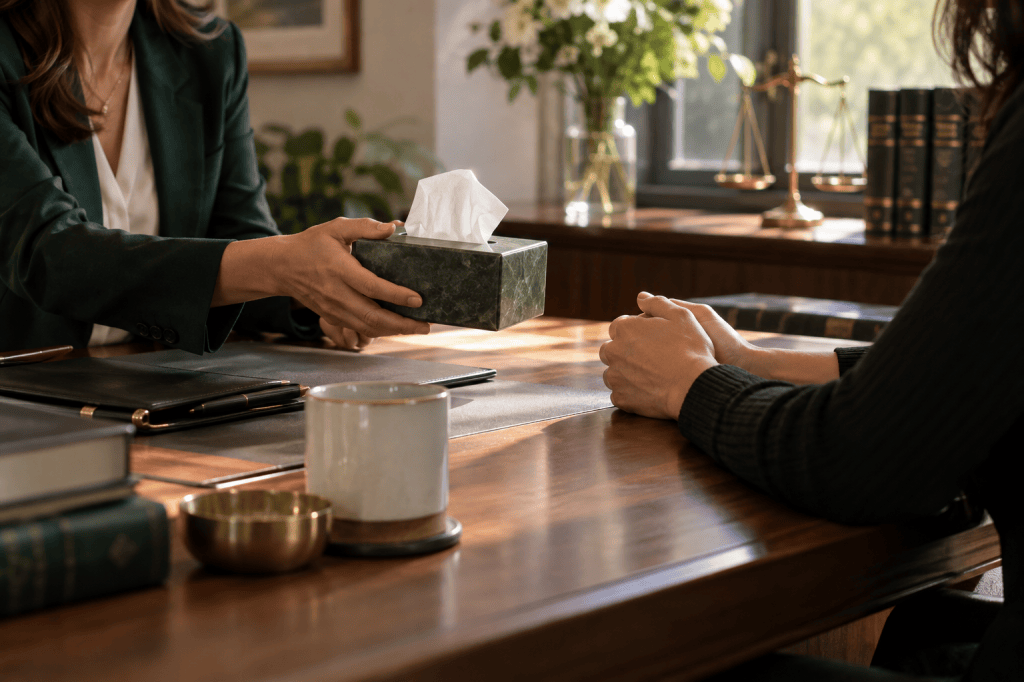
It can look like noticing that someone is becoming emotional and reaching for the box of Kleenex instead of pretending the emotion is not happening.
It can look like allowing a client to cry without rushing them through it and sitting with the discomfort of seeing someone in pain.
It can look like listening long enough to understand what someone is actually afraid of.
It can look like remaining gentle without becoming weak.
And sometimes strength cries too.
Tears do not erase anger.
They do not erase conviction.
Tears of rage are still rage.
A shaking voice can still tell the truth.
A person can be deeply affected by something and still be completely capable of standing her ground.
I think I spent years believing that being emotionally affected by something somehow diminished authority.
I do not believe that anymore.
There is tremendous strength in being able to remain present inside an emotion rather than needing to dominate the room in order to escape it.
There is strength in staying.
There is strength in listening.
There is strength in noticing.
There is strength in protecting.
There is strength in knowing when someone needs a fierce advocate and when someone simply needs another human being to sit beside them for a moment. And I can find strength in my deep desire to help.
The work I do has taught me that both are necessary.
Estate planning asks us to think about people who may not even be born yet and about what we want to leave behind for them.
Probate and trust administration bring us into families during grief.
Trust and estate litigation often asks us to walk into disputes involving not only money and property, but decades of family history.
Real estate and business law are often about protecting something someone spent years building and helping them make decisions that will affect what comes next.
These are legal problems.
But they are also human problems.
And I do not think being a good lawyer requires me to stop noticing the human being sitting across from me.
In fact, I increasingly believe that noticing is part of the work.
Lady Justice carries a sword.
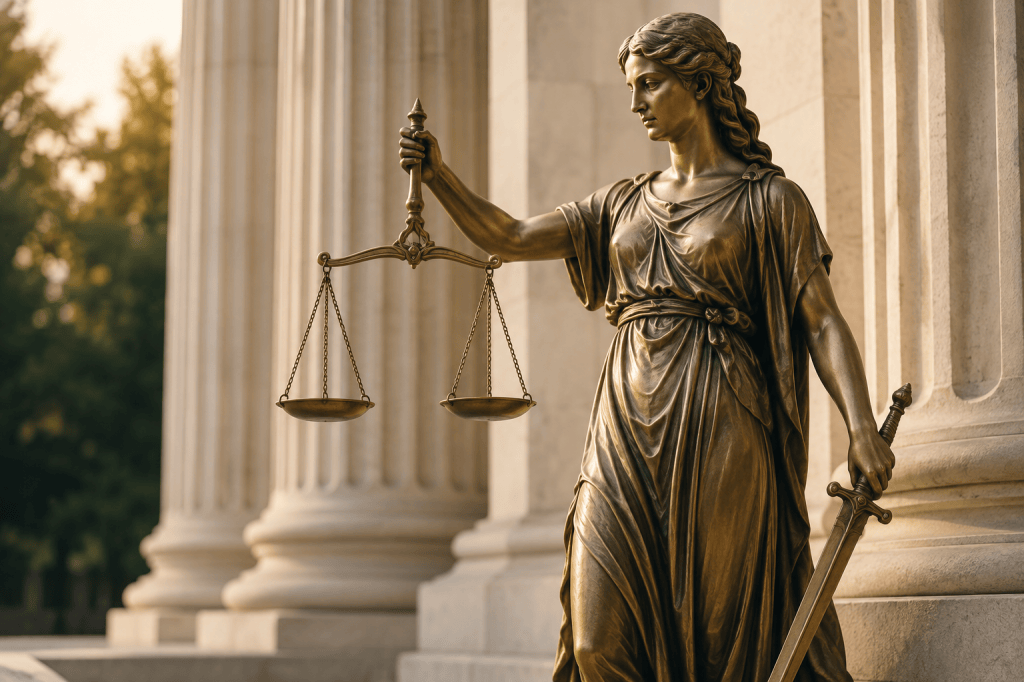
There is power there.
There are moments when the law requires us to fight, to draw boundaries, to say no, and to protect someone forcefully.
But she also carries the scales.
She weighs.
She balances.
She considers.
Power without judgment is not justice.
And perhaps strength without empathy is not the only kind of strength worth bringing into a courtroom.
The longer I practice law, the more comfortable I become with the idea that I do not need to become someone else to be powerful in this profession.
I can be soft and formidable.
I can hand someone a Kleenex and still cross-examine a witness.
I can feel deeply and think clearly.
I can be compassionate and still hold a boundary.
I can speak quietly and still mean exactly what I say.
Maybe strength does not always need to look bigger.
Maybe sometimes strength looks like remaining completely yourself in a profession that can make you believe you should be someone else.
And perhaps that is what I needed Lady Justice to remind me.
The face of justice has been a woman all along.
 Esquared Law Blog